
How we trained a 10M model with frontier performance
Time-series forecasting sits behind a lot of everyday decisions: how much stock a store orders, how much power a grid buys for tomorrow, how many people a support team puts on shift. For decades, each of those forecasts came from a model built and tuned for one series at a time.
That is changing. Time-series foundation models are transformers, the architecture behind large language models, trained on millions of series so that one model can forecast a series it has never seen, with no training on your side. They work well zero-shot, but most have 100 million to 2.5 billion parameters, which makes them slow and costly when you forecast millions of series. The smaller ones usually give something up: many take no covariates, or fall behind if the data has noise.
ChakraTS-OS-10M is our answer: a small open model that keeps up with the large ones. On fev-bench (a public benchmark of 100 forecasting tasks, run by Amazon) it is 4th of 30+ open-weight models.
This post covers how we trained it, how it works, where it stands and where it is strongest.
How we trained it
Training happens in three steps. First we build a varied corpus: public real-world series, plus generated series tuned to look like real forecasting data, with every benchmark series taken out. Then each series is cut into patches and random stretches of it are hidden. Finally one small transformer learns to predict a range for every hidden stretch, from what came before it.
How it works
How ChakraTS-OS-10M forecasts
One small decoder, every future step in one pass.

yhatlabs.com/research
1. Input. A series is cut into short patches, together with any covariates: past ones, which stop at now, and known-future ones, such as a calendar or a weather forecast, which carry on.
2. Model. One 10.6M-parameter decoder reads the patches along time and across rows, so the target can use its covariates and related series without ever seeing a value after now. The same weights read patches of 2, 4, 8 and 16 steps: short patches catch fast changes, long ones the overall shape.
3. Forecast. It fills in every future step in one pass, as a range, instead of predicting one step at a time and feeding each guess back in.
More detail is coming in our paper.
Where it stands
fev-bench skill score, open-weight models
All 100 tasks. Higher is better; bars start at 40.
fev-bench leaderboard, November 2026
On GIFT-Eval it is 7th among zero-shot models (MASE 0.674, CRPS 0.461), and on TIME (ICML 2026) it is 10th among open models (MASE 0.642, CRPS 0.537). Both are relative to Seasonal Naive, so lower is better.
Better with covariates
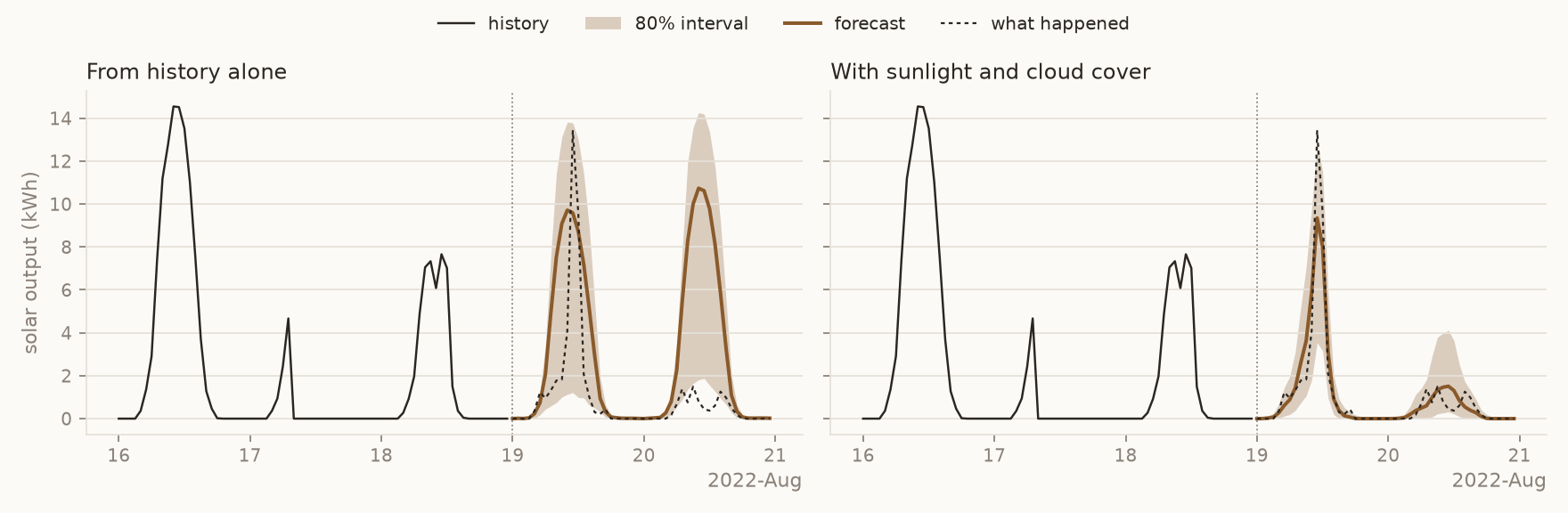
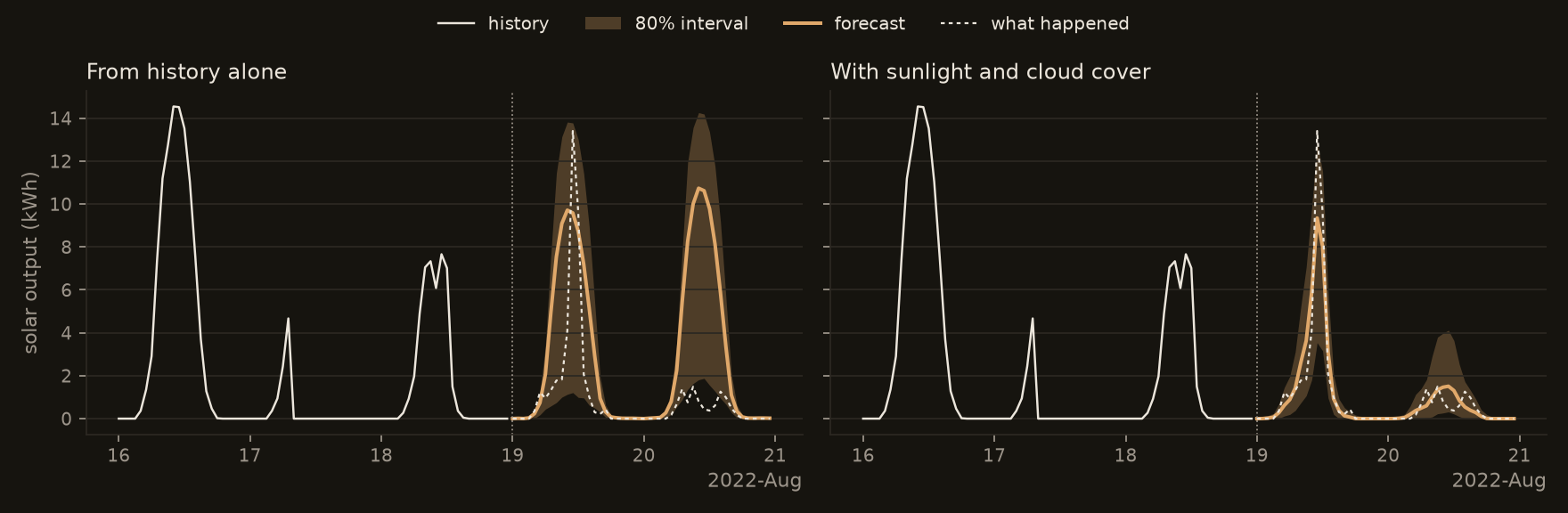
A lot of real forecasting depends on something you already know about the future: tomorrow’s weather, a planned promotion, a holiday. ChakraTS-OS-10M takes these as covariates, past or known-future, numbers or categories. On the 42 fev-bench tasks that have covariates, its skill score is 50.1, slightly above its score across all tasks.
Try it
Install the library, then forecast any series. The weights download on first use.
pip install yhatmodelsimport numpy as npfrom yhatmodels import ChakraTS
model = ChakraTS.from_pretrained("ChakraTS-OS-10M")history = 10 + np.sin(np.arange(500) / 24 * 2 * np.pi) # or your own seriesfc = model.forecast(history, h=48) # next 48 steps: quantiles 0.1, 0.5, 0.9The first download asks you to accept the model license once, with a free YHat Labs account. After that the model runs entirely on your machine. The weights are free for academic research and non-commercial use under the Chakra Non-Commercial Model License; the code is on GitHub and the weights on Hugging Face. For commercial use, ChakraTS is available through our API.
Limits
A 10M model has less room than a large one. For the best accuracy, especially on long horizons and minute-level data, use ChakraTS, our most accurate model, behind the API. ChakraTS-OS-10M reads up to 32k past points, and its forecasts lose accuracy beyond 768 steps.
Training
We trained ChakraTS-OS-10M on 8 NVIDIA H100 GPUs. We thank Baseten, Jarvis Labs and Denvr Dataworks for providing compute.
Cite
If you use ChakraTS-OS-10M in your work, please cite it. The paper is coming soon; until then, cite the model:
@misc{yhatlabs2026chakratsos, title = {{ChakraTS-OS}: open-weight time-series forecasting models}, author = {{YHat Labs}}, year = {2026}, howpublished = {\url{https://huggingface.co/yhatlabs/ChakraTS-OS-10M}}, url = {https://huggingface.co/yhatlabs/ChakraTS-OS-10M}}